

Turning wide rolls of foam, film, adhesive, felt, or rubber into usable components starts with one decision: die-cutting vs slitting. Both are core converting processes, but they produce very different results. Slitting changes the width of a roll, while die-cutting turns material into finished shapes.
This guide explains the difference between die-cutting and slitting, compares tolerances, output, cost, and lead time, and shows when die-cutting and slitting work best together, so you can choose the most efficient, cost-effective process for your project.
What Is Precision Slitting ?

Precision slitting is a continuous roll-to-roll converting process that cuts wide master rolls of flexible material into narrower rolls, strips, or spools. Instead of cutting individual shapes, slitting changes only the width of the material, and the output stays in continuous roll form. Learn more about Foamtec’s precision slitting services.
How the Slitting Process Works
A master roll is mounted on an unwind shaft, fed through cutting blades set to the required widths, and rewound into narrower custom-width rolls. Depending on the material, one of three cutting methods is used:
Razor slitting: A fixed razor blade slices the material as it passes. It suits thin films, light foams, and some tapes.
Shear slitting: Upper and lower rotary knives overlap like scissors to produce clean, straight edges on films, foils, paper, and laminates.
Score (crush) slitting: A rotary knife presses the material against a hardened anvil roll. It is commonly used for adhesive tapes, nonwovens, and some foams.
Materials Commonly Slit
Slitting works with almost any flexible material supplied on a roll, including:
- Foams such as polyurethane (PU), polyethylene (PE), and EVA
- Pressure-sensitive adhesive (PSA) tapes and transfer adhesives
- Films, foils, and laminates
- Felt, textiles, and nonwovens
See the full range of foam, film, adhesive, felt, and rubber materials Foamtec converts.
What Is Die Cutting ?
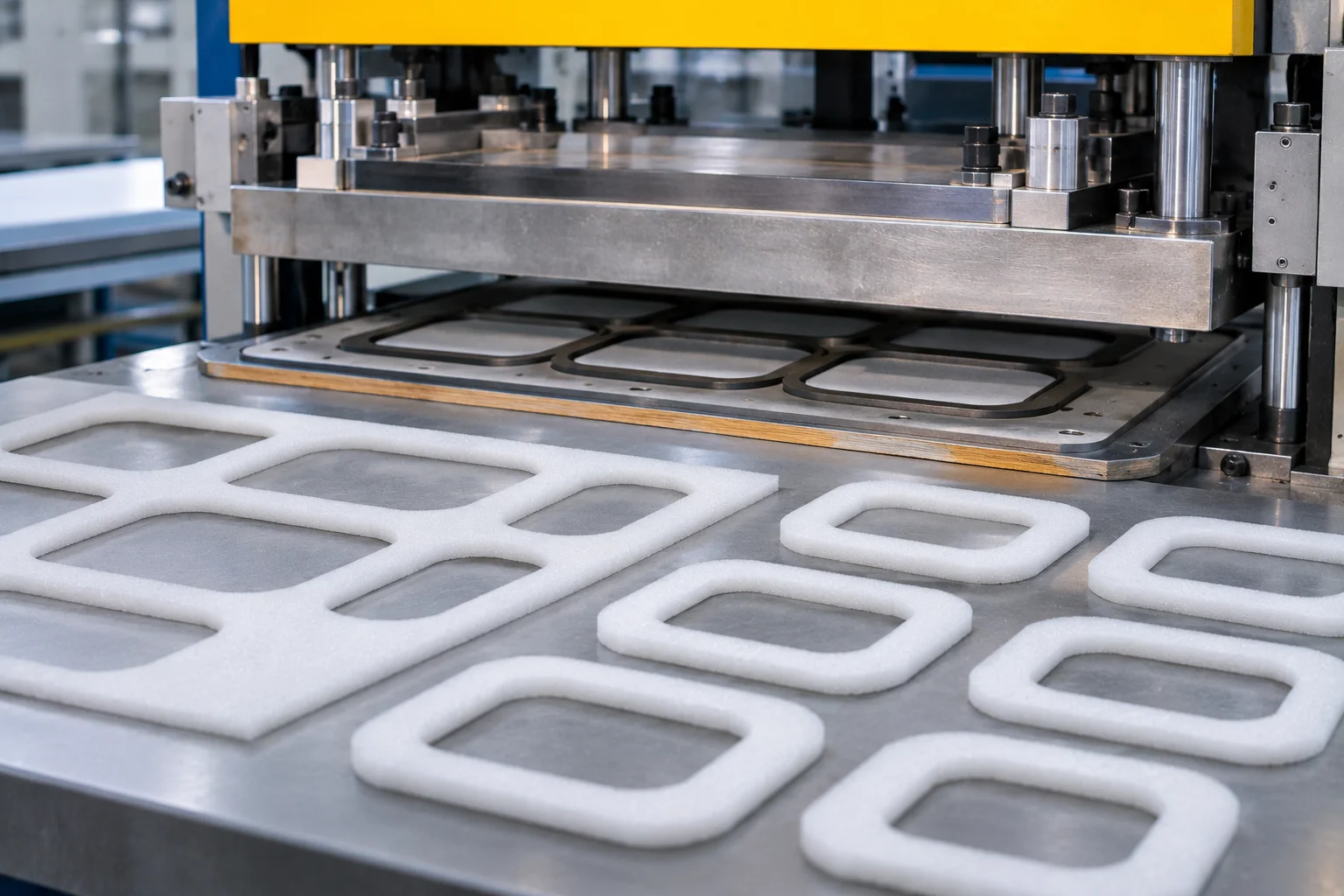
Die-cutting uses a shaped blade (the die) to cut or stamp material into a specific two-dimensional shape, or to create holes at precise locations. Depending on part design and volume, it can be done with flatbed (steel rule) dies or rotary dies. Common die-cutting methods include through-cutting, kiss-cutting (cutting the material but not the release liner), perforating, and scoring. Explore Foamtec’s precision die-cutting services.
Common Die-Cut Parts
Die-cutting is used wherever a part needs a defined shape and repeatable dimensions:
- Gaskets, seals, and flat washers
- Adhesive-backed pads, tapes, and labels
- Thermal insulation, acoustic, and vibration-damping pads
- Medical device components, such as wearable adhesive patches and equipment padding
- Protective padding and inserts for electronics
What Is the Difference Between Die-Cutting and Slitting?

The main difference between die-cutting and slitting is the output: slitting produces narrower continuous rolls, while die-cutting produces individual shaped parts. The table below compares the two processes side by side.
| Factor | Slitting | Die-Cutting |
|---|---|---|
| What it does | Cuts wide rolls into narrower rolls | Cuts material into specific shapes, holes, or kiss-cut parts |
| Output | Continuous rolls, strips, or spools | Individual parts, sheets, or kiss-cut parts on a liner |
| Tooling | Adjustable knives and blades; no part-specific tooling | Custom die made for each part design |
| Precision focus | Width tolerance, edge straightness, and consistent roll tension | Shape geometry, hole placement, and part-to-part repeatability |
| Upfront cost | Low | Higher (die investment) |
| Best for | Material preparation, custom-width tapes, automated feeding | Gaskets, seals, pads, and finished components |
Tolerances and Repeatability
Slitting: Focuses on accurate width, straight and clean edges, and even web tension along the full length of the roll.
Die-cutting: Focuses on the accuracy of the part outline, the position of holes and features, and consistent dimensions from the first part to the last.
Roll Widths vs Custom Shapes
Slitting: Output is continuous rolls or spools in custom narrower widths.
Die-cutting: Output is individual parts, sheeted parts, or kiss-cut shapes carried on a release liner for easy peel-and-place.
Cost and Lead Time
Slitting: Requires no custom tooling, so setup is fast and upfront cost is low. It is ideal for material preparation and bulk converting.
Die-cutting: Requires an investment in a custom die, but once the tooling is made, it delivers fast, highly repeatable production of complex shapes at a low cost per part.
Die-Cutting or Slitting: How to Choose

When to Choose Slitting
Choose a custom slitting partner when your goal is to downsize bulk material for the next step in production. Slitting is the right fit if you need custom-width rolls of tape or foam, consistent strips for automated assembly or pick-and-place equipment, or accurately sized material before secondary die-cutting.
When to Choose Die-Cutting
Choose die-cutting when your part has a defined shape, holes, or cut-outs, such as a gasket, seal, adhesive pad, or insulation component. It is also the better choice when you need parts supplied on a liner for fast application, or when you need thousands of identical parts with consistent dimensions.
How Foamtec Combines Die-Cutting and Slitting

Many components need both processes rather than one. In a typical combined workflow, material is first laminated with an adhesive if required, then slit to the exact width the die-cutting line needs, and finally die-cut into finished parts. Feeding pre-slit rolls straight into die-cutting reduces scrap, cuts down on handling, and keeps parts consistent.
Foamtec Specialty supports projects from prototype and short runs to full production, with value-added services including lamination, sheeting, and kitting, all backed by ISO-certified manufacturing (BSI and BV certified).
Not sure which process your part needs?
Share your material, dimensions, and volume with Foamtec Specialty, and our team will recommend the right combination of slitting and die-cutting for your project.
FAQs
What is the difference between die-cutting and slitting?
Slitting cuts wide rolls of material into narrower continuous rolls, changing only the width. Die-cutting uses a custom die to cut material into specific shapes, holes, or kiss-cut parts. In short, slitting prepares material, and die-cutting makes finished parts.
Is slitting cheaper than die-cutting?
Usually, yes, at least upfront. Slitting uses adjustable blades instead of a custom die, so setup and tooling costs are lower. However, slitting only produces rolls or strips. If you need shaped parts, die-cutting is the right process, and its cost per part becomes very low at higher volumes.
Can die-cutting and slitting be combined?
Yes. Die-cutting and slitting are often combined in one converting workflow. Master rolls are first slit to the exact width needed, then fed into a die-cutting line to produce finished or kiss-cut parts with minimal edge waste.
What materials can be slit and die-cut?
Most flexible materials can be both slit and die-cut, including foam, film, adhesives, felt, and rubber. The best method depends on the material’s thickness, density, and the final format you need. Browse Foamtec’s materials to see what we work with.
What is kiss-cutting?
Kiss-cutting is a die-cutting method that cuts through the top material, such as an adhesive-backed foam, without cutting the release liner underneath. The parts stay on the liner so they are easy to handle, store, and apply.