
The Role of Materials and Die-Cutting in LIDAR Technology
LIDAR (Light Detection and Ranging) technology has emerged as a transformative force across a wide array of modern industries. From enabling safe navigation in autonomous vehicles and robotics to providing hyper-accurate data for geospatial mapping and environmental monitoring, LIDAR systems are reshaping the technological landscape.
Central to the functionality, range, and precision of these advanced sensor systems are intricately designed internal and external components. To protect sensitive optics and maintain signal integrity, manufacturers rely heavily on advanced material science and high-tolerance fabrication.
The die-cutting process plays a pivotal role in shaping these specialized materials into mission-critical LIDAR components.
Critical Materials in LIDAR Component Manufacturing
A modern LIDAR system is a complex assembly of optical, electrical, and structural parts. Because these sensors are frequently deployed in harsh, mobile environments, such as mounted on the roofs of autonomous cars or integrated into industrial drones, selecting and fabricating the right materials is crucial to long-term performance.
Optical Materials and Lidar Transparent Films
LIDAR systems depend entirely on the unhindered transmission, reflection, and refraction of light waves. This requires specialized lenses, mirrors, and protective covers.
To shield internal sensor arrays from environmental debris without degrading the laser signal, engineers utilize specialized lidar transparent films as protective window covers. These high-performance films must maintain near-perfect optical clarity at specific near-infrared wavelengths.
Furthermore, many optical substrates feature an advanced chemical lidar coating, such as anti-reflective (AR) layers or bandpass filters, to eliminate ambient sunlight interference. High-precision die-cutting is essential when handling these materials, as it cleanly cuts the films to size without causing edge delamination, micro-cracking, or scratching the sensitive coatings.
Sealing and Environmental Insulating Materials
Sensitive internal photodetectors and laser diodes must be completely isolated from external elements. Moisture ingress, dust, and temperature fluctuations can ruin optical paths or cause electrical shorts.
Die-cut gaskets and seals crafted from high-grade silicone rubber, neoprene, or microcellular foam provide the necessary ingress protection (IP) ratings. These materials offer exceptional compression set resistance, ensuring a long-lasting, weatherproof seal.
Vibration-Damping Elastomers
In mobile applications like autonomous trucking, robotics, and aerospace, LIDAR sensors encounter constant mechanical vibrations. Left unchecked, these frequencies can distort sensor data and misalign critical optical pathways.
Die-cut pads made from viscoelastic polymers or specialized elastomers are strategically placed beneath mounting brackets and optical housings to absorb kinetic energy and stabilize the system.
Thermal Management Materials
High-frequency lasers and compact processing chips generate significant heat inside a tightly sealed LIDAR housing. Maintaining stable operating temperatures is paramount for laser wavelength stability and detector efficiency.
Thermally conductive interface materials (TIMs), such as phase-change pads or gap fillers, are die-cut to fit precisely between heat-producing components and aluminum heat sinks, ensuring optimal thermal dissipation.
Rigid Structural Components
In larger, more ruggedized assemblies, lightweight structural materials like carbon fiber composites or thin aluminum sheets are utilized for internal bracing and shielding. Precision die-cutting or stamping ensures these structural pieces are formed to exact tolerances, maximizing space inside compact sensor enclosures.
The Die-Cut Process: Transforming Raw Materials into Functional Components
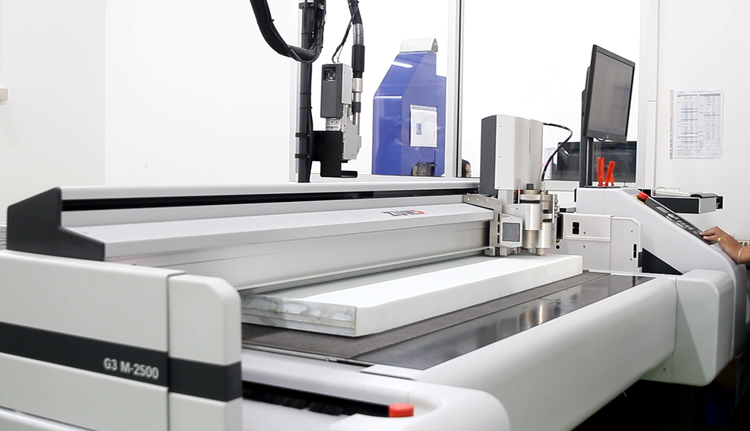
The die-cutting process bridges the gap between raw sheet stock and high-performance, drop-in components. Transforming advanced polymers and films into functional LIDAR parts requires a systematic, tightly controlled manufacturing workflow.
- Step 1: Technical Material Selection: Engineers select the substrate based on specific physical requirements, whether that means evaluating the optical transmission of lidar transparent films or assessing the thermal impedance of a TIM pad.
- Step 2: CAD Design and Specification: Digital blueprints outline the exact dimensional parameters and tolerances required for the component, factoring in any automated assembly clearances.
- Step 3: High-Precision Die-Cutting: Utilizing advanced flatbed, rotary, or laser die-cutting machinery, the material is cleanly sliced into its final shape. This step provides the extreme repeatability and tight micron-level tolerances demanded by optical assemblies.
- Step 4: Stringent Quality Control: Custom components are verified through optical measurement systems to ensure no edge defects, out-of-tolerance variances, or surface contamination occurred during processing.
- Step 5: Cleanroom Integration: The finalized die-cut components are seamlessly integrated into the sensor housing, contributing immediately to the system’s operational durability and data accuracy.
The Advantages of Advanced Die-Cutting for LIDAR Production
For Tier 1 tech suppliers and component developers, choosing a sophisticated fabrication approach yields distinct manufacturing advantages:
- Complex Geometry Execution: Die-cutting handles complex internal shapes, multi-layered adhesive laminations, and tight radial curves that traditional molding or manual trimming cannot replicate.
- Scalable Production Speed: High-speed rotary converting lines turn raw material rolls into thousands of identical, ready-to-assemble gaskets or protective films per hour, supporting high-volume commercial scaling.
- Adhesive Integration: Fabricators can easily marry functional materials, like a vibration pad or a protective film, to specialty pressure-sensitive adhesives (PSAs), simplifying final assembly lines.
Manufacturing Insight: Working with a vertically integrated precision converting partner allows LIDAR designers to prototype and scale production under controlled cleanroom conditions, protecting sensitive optical parts from particulate defects.
FAQs
Q:Why are lidar transparent films critical to sensor functionality?
A: Specialized lidar transparent films act as protective boundaries or windows for the sensor housing. They allow the laser beam to pass outward and return to the receiver with minimal signal attenuation, distortion, or scattering, ensuring the sensor retains its maximum scanning range and accuracy.
Q: How does the die-cutting process protect a sensitive lidar coating?
A: Advanced converting methods, such as laser cutting or optimized rotary tool geometry, apply precise, clean mechanical force. This prevents the microscopic fraying, edge chipping, or delamination that can occur when cutting optical materials that feature an anti-reflective or protective lidar coating.
Q: Can die-cut gaskets withstand the extreme outdoor conditions required for autonomous vehicles?
A: Yes. By utilizing high-performance materials like silicone rubber or closed-cell fluorosilicone foam, die-cut gaskets maintain their elasticity, ozone resistance, and sealing pressure across a broad temperature array, preventing dust and moisture ingress over years of road exposure.
Q: What type of die-cutting is best for complex thermal interface materials (TIMs)?
A: Flatbed or rotary die-cutting paired with a release liner is ideal for TIMs. Because these materials are inherently soft, sticky, and fragile, precise cutting pressures and automated liner systems are necessary to keep the parts from deforming or tearing before they are manually or robotically placed onto the electronics.